
A chatbot script template helps businesses standardize the goals, questions, data to collect and handover conditions for each consultation journey. However, customers rarely communicate in the exact order of a fixed flowchart; they may send photos, change their needs, use abbreviations or ask several questions in the same message.
Therefore, digitizing scripts with an AI Agent does not mean discarding the structure you have built, but turning that structure into a more flexible business framework. In this article, Agent-X presents the structure of a sales chatbot script, industry-specific examples and how an AI Agent leverages context, data and operating rules to handle real-world situations more effectively.
The structure of a sales chatbot script
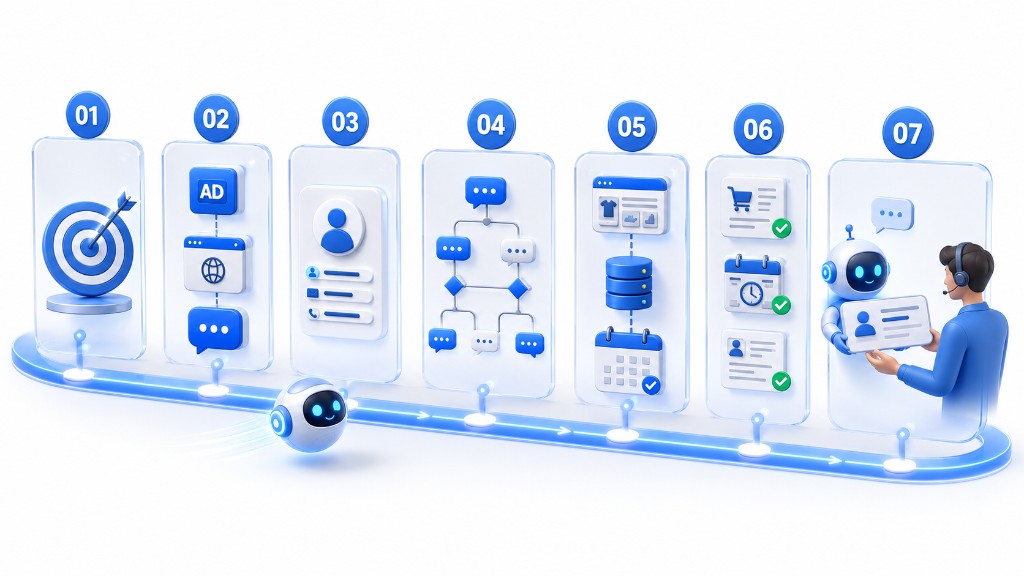
A chatbot script template should have seven components:
- Goal: what outcome should the customer achieve after the conversation?
- Entry point: does the customer come from an ad, a product page, the website or another channel?
- Input information: what data is already available and what data still needs to be asked for?
- Consultation logic: which conditions lead to each recommendation or processing step?
- Data sources: where do products, prices, inventory, schedules or policies come from?
- End point: booking an appointment, creating an order, leaving contact details or getting an answer?
- Handover: which situations must be transferred to staff, and what data should be passed along?
A sales script typically goes through three stages: identifying needs, recommending solutions and confirming the action. Each step should only ask for information that is truly necessary. If the customer has already provided size and color in one sentence, the bot should not ask for each field again.
Some traditional sales chatbot script templates
Fashion chatbot script: The script should ask about product type, intended use, size or measurements, color and budget. When a customer sends a sample photo, the system can identify the product, ask for the missing size, check inventory, suggest equivalent options if the item is out of stock, then confirm delivery details or hand over to staff when the customer needs styling advice.
Real estate sales chatbot script: The script focuses on location, property type, budget range, purchase purpose and expected timeline. The flow should provide relevant information, assess the customer's readiness and then propose a consultation or viewing appointment; it should not ask for too much personal information in the very first exchange.
Restaurant chatbot script: The script usually revolves around table reservations, viewing the menu, ordering food and post-order support. For reservation requests, the bot needs to confirm the time, number of guests, seating area, special requests and contact details; cases involving allergies, private parties or last-minute changes should be handed over to staff.
Why do fixed scripts easily lose closing opportunities?
Opportunities are rarely lost because of a single wrong answer. They slip away through many small points:
- The customer cannot find a suitable option in the menu.
- The bot asks again for information the customer has already provided.
- The answer is on topic but about the wrong product or at the wrong stage.
- The flow ends before recognizing that the customer is ready to buy.
- The customer has to wait a long time to reach a staff member.
- Staff take over but have no history and must ask everything again from the start.

The root cause is that customers do not converse according to the structure of a flowchart. They may change their minds, go back to an earlier question or provide several pieces of information at once. If every situation requires adding another branch, the script quickly becomes hard to manage.
Digitizing the sales process with a new generation of intelligent AI Agents
Instead of discarding all the scripts they have built, businesses can use them as a framework for AI to understand goals, limits and mandatory business steps. On that foundation, the AI Agent flexibly handles natural phrasing, leverages authorized data and collaborates with people in situations that require deep expertise.

Automated context-aware consultation and flexible objection handling
An AI Agent can use a chatbot script template as business guardrails while analyzing natural language to choose the appropriate step. The system records the information the customer has provided, retrieves data it is permitted to use and handles phrasing that falls outside the flow without overstepping policy on its own.
Automating handover to specialist consultants
When a customer needs to negotiate wholesale prices, file a complaint or makes an out-of-scope request, the system can trigger a handover. Staff receive the full consultation history, the identified needs and the reason for the transfer so they can take over seamlessly, minimizing the need for customers to repeat information.
Increasing average order value through up-selling and cross-selling
Based on needs, interaction history and approved rules, AI can recommend add-on products or better-suited options. Recommendations should only appear when they are genuinely relevant, be transparent about pricing and not disrupt the main goal of the conversation.
Frequently asked questions about digitizing chatbot scripts with AI Agents
Below are short answers to help businesses understand how to convert their existing chatbot scripts into a more flexible AI Agent model.
Do you need to rebuild all your chatbot scripts when switching to an AI Agent?
No. Businesses can keep their goals, business rules and mandatory steps, then let the AI Agent flexibly handle conversations according to each context.
Does an AI Agent still need a chatbot script template?
Yes. The script template remains a guiding framework that helps AI understand the process, handling limits and the outcomes to achieve, but it does not force customers to follow a fixed conversation flow.
How do you keep an AI Agent from advising beyond the script?
Businesses need to clearly define the data to be used, the permitted scope of answers, action rules and the cases that must be handed over to staff.
Which scripts should be prioritized for digitization first?
Prioritize scripts with high conversation volumes, frequent off-flow situations and a direct impact on orders or appointments, in order to produce measurable business results.
How do you evaluate effectiveness after digitizing scripts?
You can track the rate of fully resolved conversations, the conversion rate, the number of times AI has to hand over and the reduction in repetitive tasks for staff.
Conclusion
Digitizing scripts with an AI Agent helps businesses maintain control over their processes without depending on every fixed dialogue branch. The script becomes the foundation for AI to understand goals, coordinate data, perform tasks within the permitted scope and bring in people at the right time. This is the basis for building a sales journey that is flexible, consistent and directly tied to business results.