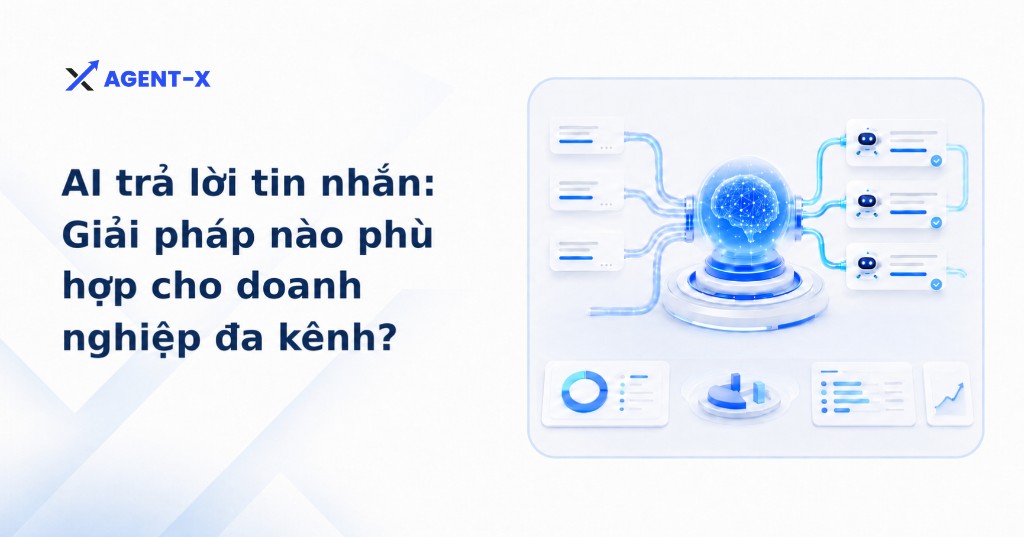
A customer may start a conversation on Facebook, continue researching on the website, and finalize the purchase decision through another channel. Along that journey, response speed is only the starting requirement; businesses must also maintain the right context, use consistent data, and move the conversation to the next processing step.
In this article, Agent-X examines how AI auto-reply messaging technology works, the common levels of automation, and the criteria for choosing the right solution. Through this, businesses can assess why an effective omnichannel system needs to go beyond simply sending answers in order to directly support sales goals.
How does AI auto-reply messaging technology work?
When a message arrives, the system typically runs through a processing sequence that includes:
- Identifying the sender, the channel, and related history.
- Recognizing the intent and details such as product, color, size, or order number.
- Checking for missing information or content that needs clarification.
- Retrieving data from approved sources.
- Generating a response, performing a task, or transferring to a staff member.
An AI chatbot can understand many ways of expressing the same need. But to answer correctly in a business setting, the system must also correctly identify what is being referred to. The question “is this one still available?” only makes sense when the AI knows which product “this one” is, from an image, a link, or a previous exchange.
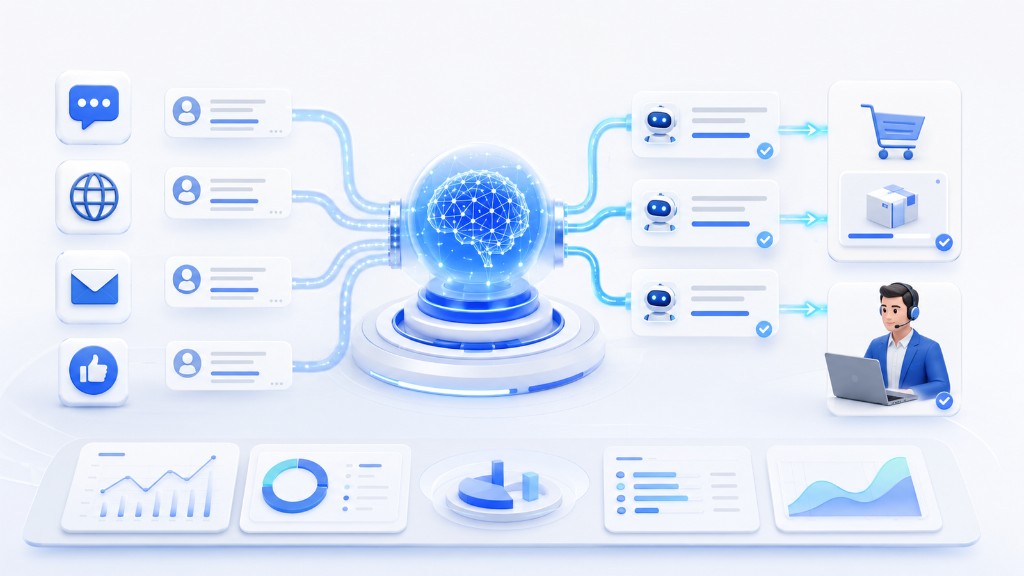
Response quality therefore depends on four layers:
- Model: the ability to understand language and generate answers.
- Context: relevant information within the conversation.
- Data: products, policies, inventory, or business status.
- Control: response limits, confirmation conditions, and handover.
If any of these four layers is missing, the AI may respond quickly but will not necessarily help the customer resolve their need.
Levels of message automation
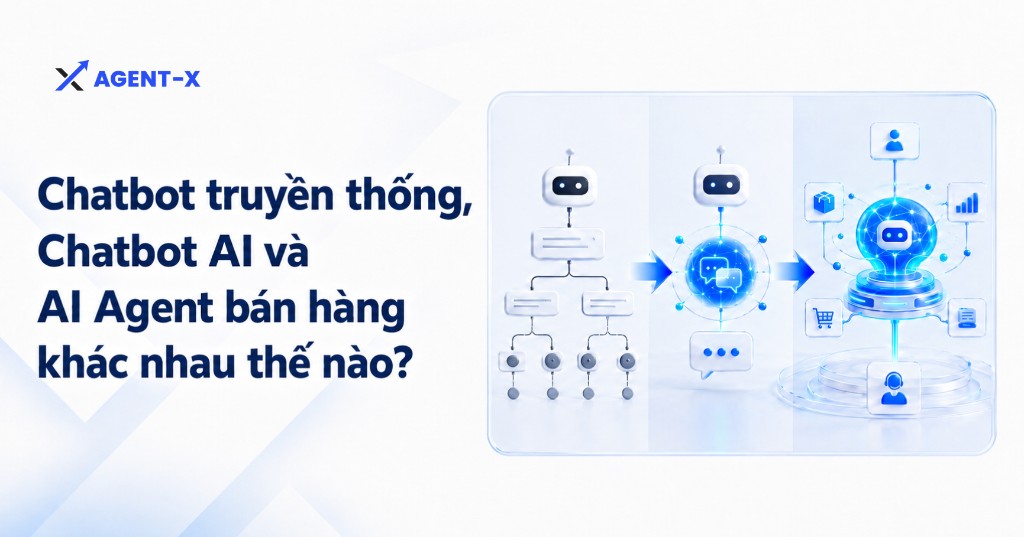
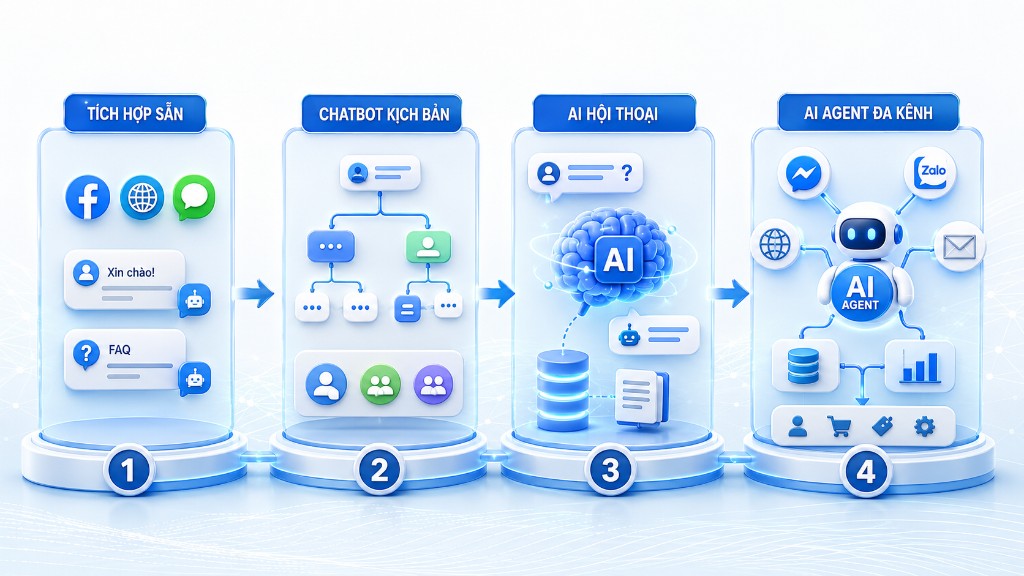
Conversation automation tools can be classified into four levels based on their ability to understand language, maintain context, connect data, and perform tasks. This classification helps businesses correctly identify the capabilities they have and avoid equating a simple auto-reply feature with an AI Agent system.
Level 1: Preset messages
This includes greetings, away messages, FAQs, and quick replies on social networks or e-commerce marketplaces. This group is easy to deploy and suitable for basic information, but it does not understand context.
Level 2: Script-based chatbots
The system uses menus, keywords, and flows to classify requests. Businesses can build sample chatbot scripts for lookups, information collection, or routing to departments. It works well for stable processes but easily takes the wrong branch when customers phrase things freely.
Level 3: AI chatbots
An AI chatbot understands natural language, maintains context, and retrieves information from a knowledge base. The system can respond more flexibly, but its ability to perform tasks still depends on integrations.
Level 4: AI Agent
An AI Agent connects conversations with data and tools. The system not only answers but can also check conditions, help create orders, book appointments, update information, or hand over with a summary.
Businesses do not necessarily need to start at the highest level. The right level depends on the complexity of the conversations, the data required, the actions to be performed, and the level of risk.
An overview of popular auto-reply messaging tools
On the market today, messaging reply solutions come in many forms, from the built-in features of individual platforms to multichannel AI Agent systems. Each tool group suits a different level of complexity in terms of conversations, data, and operational processes.
Built-in platform features
Facebook, websites, e-commerce marketplaces, and many messaging platforms support greetings, away messages, or FAQs. The advantages are ease of use, low cost, and suitability for instant responses at the first step. The drawback is that data and history are usually siloed by channel.
Third-party chatbot software
This group allows building complex flows, segmenting customers, and connecting to some systems. If the logic still relies entirely on fixed branches, the team must frequently revise scripts whenever products or customer behavior change.
Conversational AI platforms
These platforms use AI to understand questions, find information, and generate responses. Businesses need to evaluate their ability to govern data sources, set policies, and monitor quality, rather than just looking at a chat demo.
Omnichannel AI Agent platforms
This group aims to connect conversations, data, and tasks across multiple channels. Evaluation criteria include customer identification, context retention, system integration, action permissions, handover, and outcome reporting.
Why are standard auto-reply settings not enough to close sales?
Fixed messages do not know which product a customer is interested in, what has already been discussed, or which stage of the buying journey they are at. When an answer is out of context, the customer has to provide information again and is more likely to leave the conversation.
Even when AI can produce natural-sounding answers, the process still breaks down if staff have to open multiple systems themselves to check inventory, policies, order status, or availability. The gap between “responded” and “resolved” lies in the ability to connect data with the next action.
From auto-replies to AI Agents that proactively handle omnichannel conversations
AI Agents mark the shift from automating answers to automating part of the sales process. The system not only analyzes message content but also determines the customer’s status, chooses the next processing step, and uses data or tools within its granted permissions. This difference is clearly reflected in three core capabilities:
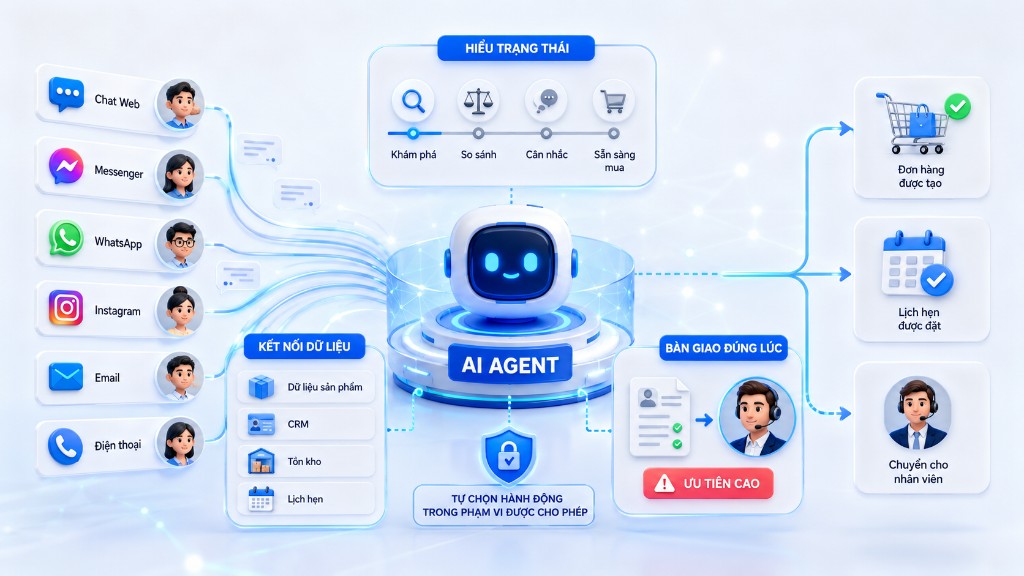
Understanding the state of the conversation
The system determines whether the customer is researching, comparing, considering, or ready to buy. Based on that, the AI chooses suitable questions and processing steps instead of sending the same content to everyone.
Connecting data with tasks
AI can retrieve from authorized sources, check conditions, and perform operations within established limits. Before any important action, the system needs to reconfirm the data with the customer.
Handing over at the right time
When facing complaints, negotiations, out-of-scope requests, or high-value buying signals, the AI transfers the conversation to staff along with a summary and priority level.
Criteria for choosing an AI messaging reply solution
Businesses should evaluate solutions using these questions:
- Does the system understand context across multiple turns and multiple channels?
- Does it clearly show the data sources used for answers and when they were last updated?
- Does it set tool permissions and require confirmation before important actions?
- Does it have mechanisms to decline, ask follow-up questions, and hand over when data is missing?
- Does it store history and task logs, and allow decisions to be reviewed?
- Does it measure resolution rate, conversion, and handover quality in addition to response speed?
The right solution does more than answer well in a demo. It must operate reliably with real data, exception cases, and the business’s own processes.
Frequently asked questions about omnichannel AI auto-reply messaging
Below are brief answers to help businesses choose and deploy an AI messaging reply solution suited to their omnichannel sales operations.
Which channels can AI reply on simultaneously?
Depending on the solution, AI can receive and process messages from websites, Facebook Messenger, Zalo, WhatsApp, Instagram, email, and other channels within a single system.
Does AI remember conversation history across channels?
AI can only maintain cross-channel context when customer data and conversation history are synchronized. If channels operate separately, the AI may fail to recognize that it is the same customer.
Can AI automatically close orders or book appointments?
Yes, if the AI is connected to product, inventory, order, or availability data and is granted permission to perform business tasks within a defined scope.
When should AI transfer the conversation to a staff member?
AI should hand over when data is missing, when it encounters out-of-scope requests, when it detects sensitive situations, or when it identifies customers who need in-depth consultation and have high conversion potential.
Where should a business start when deploying omnichannel AI?
Start with the channel that has high conversation volume, relatively clear processes, and easily measurable results. After the pilot phase, the business can expand to other channels and business operations.
Conclusion
AI message replies help businesses respond quickly and handle many conversations simultaneously. Greater value emerges when AI correctly understands context, uses the right data, and moves the conversation to the next step.
For the omnichannel challenge, businesses should look at the entire journey instead of optimizing individual message templates in isolation. The ultimate goal is not “the bot has replied”, but that the customer has been advised, booked an appointment, placed an order, or been connected with the right person.